The AI Engineering Cycle
Emergence from disciplined iteration
Goal → Prototype → Test → Enhance ↺
Build the smallest useful system. Test it against reality. Meet the goal. Make the next version better.
Introduction to the AI Engineering Lab
Author: Ed Kulis — June 2026
When I took Engineering 1 at Rensselaer Polytechnic Institute in the 1970s, the course stretched my mind with questions that did not come prepackaged as textbook exercises. Does a thundercloud contain the energy of an atomic bomb? How much water would be saved by covering a reservoir with a plastic sheet? If a tunnel blockage is cleared, how long will it take before the backed-up traffic returns to normal speed? These were not just calculation problems. They required research, estimation, judgment, synthesis, and the slow development of an engineering way of thinking.
Today, AI can perform much of that research and synthesis almost instantly. It can estimate, compare, calculate, explain, write code, generate test plans, and even show a kind of practical wisdom in evaluating the next effective step in a build. That changes the central question for engineering education. If AI can accelerate thought, what must we do to train the engineering mind?
The answer is not to retreat from AI, but to move deeper into engineering. AI still needs guidance. It does not yet know what is worth building, what direction is useful, or how to turn a concept into a reliable physical creation without human purpose, constraint, and judgment. Most importantly, AI does not yet possess general physical agency. It cannot, on its own, build the broad range of useful physical objects that human engineers imagine.
That gap is the opportunity. An age of AI abundance is approaching, with the cost of creation falling rapidly. The next generation of engineers should be trained not merely to solve problems on paper, but to build systems that build things: machines, tools, robots, fixtures, and automated processes that bridge the gap between concept and creation.
An AI Engineering Lab can replace Engineering 1 of the past. The rules of the lab will allow students to build with off the shelf components, pre-machined or 3D-printed components, provided each component enters the build as a single solid block. The emphasis is on final assembly: the product itself must come together untouched by human hands. Students should therefore be encouraged to divide into teams that create subassemblies—sensing, motion, fixtures, joining mechanisms, software, and control—then combine them into a final system. That makes the lab a true systems-engineering exercise, where separately created capabilities must fit together, communicate, and become a working whole.
I remember Engineering 1, in 1972, fondly because it taught me how to think like an engineer. Today’s students need that same mental stretching, but for a new age. They must learn to guide AI, impose useful constraints, test reality honestly, and devise machines that can instantiate ideas as practical, reliable creations. That is the purpose of the AI Engineering Lab.
A New Model for Engineering Education
The AI Engineering Lab
Author: Ed Kulis — June 2026
Welcome to the AI Engineering Lab.
Your first assignment is a No-Hands Build.
You are not allowed to touch nor directly manipulate anything you build.
Build something. Begin.
The Core Idea
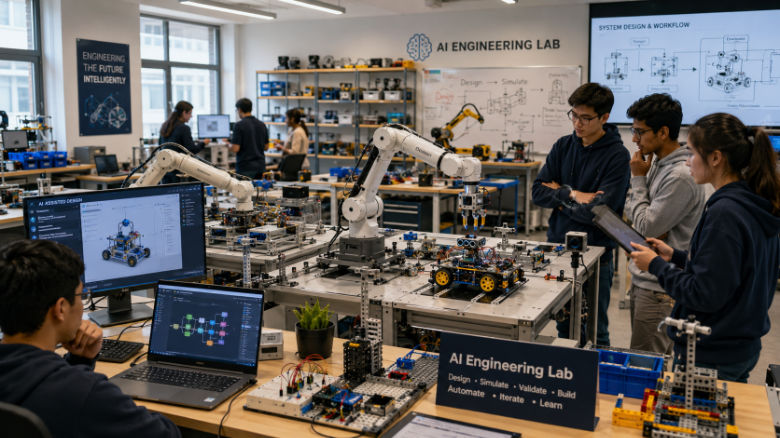
The AI Engineering Lab is a hands-on environment built around one central constraint: students may design anything, but they may not physically touch anything they build nor may they directly operate any mechanism that manipulates the build, no joysticks or realtime adjustments. They begin with purchased robots, simple tools, sensors, Arduino boards, LEGO, grippers, cameras, glue guns, fixtures, and basic fabrication equipment. Human hands may stock and maintain the lab. Pre-machined or 3D-printed parts are allowed if they enter as single solid blocks, not pre-assembled mechanisms. The final assembly of the product must be performed by machines, robots, or other student-created systems, untouched, and not manipulated in real time by human hands.
The point is not to make the work easy. The point is to make it engineering. Students must turn goals into physical systems through the cycle: Goal, Prototype, Test, Enhance. The cycle runs and the goal is met at every level of build from the smallest assembly to the final product. They learn interfaces, tolerances, feedback, sequencing, failure modes, materials, recovery, and judgment because every idea must confront the real world.
Role of AI
AI is not treated as a chatbot bolted onto a course. It becomes part of the engineering environment. Students use AI to brainstorm, plan, simulate, write code, generate tests, interpret failures, and document results. But AI does not remove engineering judgment; it increases the need for it. Students must decide what matters, what to try next, and what not to do.
First Projects
Early projects can be deliberately crude: robots that move parts, aim glue guns, push buttons, join LEGO structures, place wires, trigger cameras, sort components, or build small battle-bot-like machines. Students should be encouraged to divide into groups that create subassemblies, then combine them into final products. One function creates the possibility of the next: push a block, position a part, assemble a structure, build a tool, improve the builder.
What Students Learn
Physical constraints are the curriculum.
The hard part is not abstract intelligence, but usable agency in the world.
Failure becomes data.
Every breakdown is instrumented, studied, and folded into the next prototype.
Special-purpose robots matter.
The revolution is not only humanoid robots, but useful machines building useful things.
Order emerges from capability.
Students learn to combine messy, partial functions into systems that work.
Educational Outcome
Students leave with engineering reflexes: define the goal, reduce the problem, build the smallest useful system, observe failure honestly, improve the mechanism, and repeat. They learn that intelligence alone is not enough. To change the world, intelligence must be given tools, constraints, feedback, and agency.
The AI Engineering Cycle
Emergence from disciplined iteration
Goal → Prototype → Test → Enhance ↺
Build the smallest useful system. Test it against reality. Meet the goal. Make the next version better.
A Systems Discipline for Engineering Minds
The No-Hands Build
Traditional robotics projects teach students to build machines
The No-Hands Build teaches students to build systems that can build machines.
Beyond Traditional Robotics
Traditional robotics projects teach students how to design, fabricate, assemble, and program machines. The AI Engineering Lab adds a fundamentally different discipline: students must learn to engineer the process of creation itself.
By prohibiting human hands from touching anything that is ultimately built, students are forced to think beyond individual components and consider fixtures, tooling, alignment, part presentation, error recovery, autonomous assembly, testing, and iterative capability development.
Every design decision must account not only for what the robot will do, but also for how the robot — or another machine — will construct, inspect, and improve it.
The Educational Shift
This shifts engineering education from product-focused thinking to systems-focused thinking, where manufacturing, automation, software, mechanical design, and operational planning become inseparable.
The Result
An educational environment that develops deeper engineering judgment, greater appreciation for real-world constraints, and a mindset oriented toward building capabilities that can continuously create new capabilities.