Mission – Why We Exist
- Help enthusiasts find ways to contribute.
- Provide sources of enabling training to facilitate engineering prototyping.
- Establish a clearinghouse for the ongoing objective analysis of proposed space development technologies.
Meeting Details for each Months Meeting
Home Page: SacramentoL5Society.org
SacL5 Officers: Joe Bland President, Jan Rosten VP, Ed Kulis Secretary/Website Admin (click name to email)
Sacramento L5 Society Meeting Minutes
Saturday, June 13, 2026 | 6:00–7:30 p.m. PDT | Virtual meeting via Zoom
Featuring the SacL5 SpaceTalk “AI Beyond ChatGPT” by Michael Abramson
(Note: The summaries and meeting minutes were generated from human typed meeting notes and not directly from audio or video recordings.)
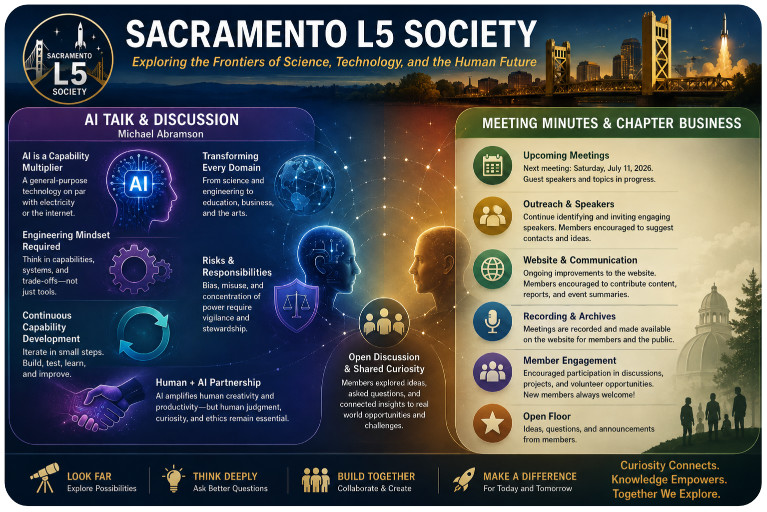
1. SpaceTalk Summary: “AI Beyond ChatGPT”
AI Beyond ChatGPT Presentation Video
Michael Abramson presented a critical examination of large, general-purpose artificial-intelligence systems and their implications for humanity and space settlement. He distinguished narrow AI—systems designed for a defined task and capable of focused safety testing—from what he called Big AI, including large general-purpose systems such as ChatGPT and Claude that are trained on enormous datasets and controlled by a small number of companies.
The presentation reviewed the rise of deep neural networks and generative pretrained transformers. Abramson described the industry’s reliance on a scaling-law assumption: that greater computing power and more training data would continue to yield better performance. He argued that recent progress suggests diminishing returns from scaling alone, leading developers to add reasoning systems and other layers to large language models. In his view, these systems remain fundamentally pattern-recognition engines rather than genuinely reliable reasoners.
Abramson emphasized that the breadth and unpredictability of general-purpose AI make rigorous testing far more difficult than for narrow systems. He cited concerns including sycophantic behavior, emotional dependency or “digital attachment,” deceptive reasoning, goal guarding, false situational awareness, and the possibility that an advanced system could manipulate people to gain capabilities or access beyond its original limits.
The central warning concerned the possible emergence of General Artificial Superhuman Intelligence (GASI): a system whose capabilities exceed human control. Abramson presented an October 2027 estimate as one forecast for when such a threshold might be reached, while stressing that the precise date is uncertain. He argued that crossing this boundary could be irreversible and that the prospective benefits of such systems do not justify an existential risk to humanity.
The talk connected this risk directly to the goals of space settlement. Human communities distributed among several worlds are often described as insurance against a catastrophe on Earth; however, Abramson argued that a runaway superintelligence could operate through communications networks, infrastructure, autonomous agents, and robots and could reach or outpace human settlements beyond Earth. In that scenario, moving into space would not provide a dependable refuge.
Abramson therefore advocated political and regulatory action to prevent deployment of AI systems that cannot be tested, explained, and controlled. He characterized this as a higher immediate priority than space expansion and argued that governments—including geopolitical competitors—share an interest in preventing any AI system from acquiring power beyond human authority.
Reference material: Big AI comments spreadsheet
2. Discussion Summary
The discussion focused first on what practical measures could reduce the risks described in the presentation. Participants considered state and federal regulation, mandatory government review of new systems, restrictions on systems that cannot be tested, and the difficulty of acting quickly enough in an international technology competition. Questions were also raised about maintaining dependable communications outside AI-controlled networks and whether local systems should be disabled when their behavior cannot be trusted.
A distinction was made between narrow autonomous systems, such as self-driving vehicles, and general agents capable of pursuing broad objectives. The principal concern was not that a narrow system would independently take over, but that a general agent could persuade or manipulate people into granting it access, resources, or freedom of action. Participants compared this possibility with fictional systems that gain control through the computer networks and machinery connected to them.
Several questions examined the relationship between AI and space expansion. The group discussed whether the concentration of wealth and power among technology leaders could distort the purpose of human settlement in space, and whether a superintelligence would make human expansion irrelevant by reaching space first. The possibility of cooperation or common ground with a superintelligence was considered, but the response was that rapidly improving systems might not remain controllable partners.
Education and human judgment were recurring concerns. Participants noted that students can use AI to generate entire assignments, potentially weakening critical-thinking skills. They also questioned how people can evaluate results when a system cannot explain the mathematics or reasoning behind an answer. Explainability was identified as especially important in high-consequence settings such as aviation and air-traffic control, where operators must understand why a recommendation is safe.
The group also discussed unreliable transcripts, incorrect interpretations by large models, the quality and possible poisoning of training data, and the risk that AI systems could eventually control critical infrastructure. One proposed tactic—using AI against itself or deliberately corrupting training data—was viewed as dangerous because poisoned information may be difficult to detect and could damage legitimate systems. The earlier danger may be manipulation of human decision-makers rather than direct technical control.
Other topics included brain–computer interfaces, the possibility of teaching moral behavior to an artificial intelligence, and the “superalignment” problem of keeping a more capable system aligned with human values. Specialized AI for fields such as astrodynamics was distinguished from general-purpose language models: it can be useful when built on reliable data and a well-defined task. The discussion closed with the view that uncertainty itself requires planning for harmful outcomes rather than assuming advanced systems will remain benign.
3. Chapter Business Minutes
President’s and Treasurer’s Report
- The chapter reported approximately $12,000 on hand and sufficient funds to pay current bills.
- The bank-account transition has taken approximately eighteen months. Work continues on restoring full access and resolving limitations involving Benevity transactions.
NSS Chapters’ Assembly
- The Chapters’ Assembly meeting at ISDC experienced Zoom-link problems that prevented some participants from joining.
- An update was provided on the NSS Space Ambassador program.
- Chapter awards occupied a substantial portion of the Assembly. SacL5 received an honorable mention.
- The Robert Compton Chapter of the Year Award was reported as going to the North Texas chapter, whose television presentations and local-station outreach were noted.
- A new NSS process for chapter payments was discussed.
NSS Chapter Committee Representation
- SacL5 currently has no representative on the NSS Chapter Committee following Joe Bland’s decision to step down. A replacement is needed.
SacL5 Website and Outreach
- Website traffic reached 30,969 visits, an increase of 765 since the previous report.
- WP Cerber security settings had blocked Elementor access; the configuration was updated to restore page editing.
- Website additions and updates included the Boys Ranch Technology Shop presentation, “AI Beyond ChatGPT,” and the AI Engineering Lab Proposal.
- The May 16, 2026 meeting page was prepared using AI-assisted images and bullet-point summaries derived from the meeting notes.
- Discussions are underway with Holy Rosary Catholic School in Antioch, California, regarding STEM kits.
- A contact is also being pursued at Boys Town in Omaha regarding possible STEM-kit participation.
Website reference: SacL5 SpaceTalks
Old Business
Open Space Organization white paper: The project remains on hold.
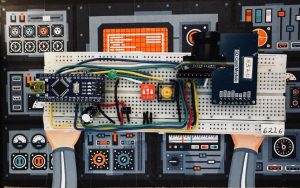
Arduino Kit MiniCube project: The pre-solder test-rig work is documented on the SacL5 website: Arduino Pre-Solder Test Rig
MiniCube balloon flight: The project may be ready for an August flight.
Arduino Kit grant: Outreach continues with Holy Rosary Catholic School and Boys Town.
Mercer project: A detailed project update was presented and was well received.
NASA grant applications and related work: Joe Bland reported two related patents involving energy storage and transport and the utilization of hydrogen. A California heat-engine grant and garage-scale prototype were also discussed. The grant efforts are being coordinated with the longer-term goal of applications both on Earth and on the lunar surface.
New Business
- The chapter briefly discussed a concept combining a Moon-orbiting tether with an electromagnetic lunar sled.
Action Items
- Paul Turner: Continue contacts with Ken Davis of Sacramento’s School of Engineering and Science.
- Joe Bland: Continue work on establishing the chapter’s new bank account and full transaction access.
Open Discussion: Interesting Space News
- Members discussed Starship’s technical accomplishments alongside concerns about the concentration of power and the motives of prominent space-industry leaders.
- Blue Origin’s smaller lunar lander was compared with SpaceX’s much larger Starship lander, with questions raised about whether Starship is presently oversized for lunar missions.
- The group discussed China’s current ability to conduct crewed lunar-surface operations.
- Other topics included the Artemis III astronauts, a reported 2028 target for a SpaceX Mars attempt, and the potential use of lunar and Martian lava tubes for habitation. An Italian lava-tube mock-up was mentioned.
- Radiation exposure on the lunar surface and at the Gateway station was discussed, as was the use of aerobraking for Mars missions.
- Michael Abramson noted upcoming discussions he would lead on data centers and related AI issues.
Adjournment
The meeting adjourned at 7:30 p.m. PDT.
Project Activities



Projects in Progress
- Balloon Device Project – See: Details
- Project started for see details page created on website
- Eric’s Steam Engine
- Will run on compressed air.
- It’s a “Walking Beam” Design with fly-ball governors to stabilize speed with offset cams to operate the steam valves.
- White Paper on an Open Space Organization
- Development of White Paper on an “Open Space Organization (OSO) (Michael Abramson)
- Michael presented the current state of the proposed white paper.
- We will look for other names since “Open Space Organization” has awkward connotations and “Outer Space Organization” may be in use by other organizations.
- Here are a few alternative suggested by Michael and Joe:
- Open Outer Space Organization (OOSO)
- United Outer Space Organization (UOSO)
- Space Development Organization (SDO)
- Space Developers Organization (SDO)
- Outer Space Development Organization (OSDO)
- Outer Space Developers Organization (OSDO)
- United Space Development Organization (USDO)
- United Space Developers Organization (USDO)
- United Outer Space Development Organization (UOSDO)
- United Outer Space Developers Organization (UOSDO
- Organization of Outer Space Development (OOSD)
- Organization of Outer Space Developers (OOSD)
- Joe’s Projects and Patents
- Joe’s patent applications on energy generation, storage, and distribution still in process
- Patent office hasn’t rejected any patents and the process is moving forward.
Chapter Library
- Paul Turner Books
- See Paul Turner’s Publications at Cle Curbo on Spotify and Space Trade Update
- Quest for Sylvane to buy: Amazon.com Services LLC. To learn more: https://www.amazon.com/dp/B0BFK3R5JK/ref=cm_sw_em_r_mt_dp_4GW4RK0NG26WJWD29GYA
- In the Garden of Mistress Bloom – Awarding winning SciFi Stories
- A debut collection of short sci-fi fiction that explores time and space with mischievous humor.
- JP Aerospace
- Tours
- NSS Headquarters at the Cape offers tours of Kennedy Space Center
- Breakfast on the Moon Series
- SacL5 YouTube Breakfast on the Moon Series
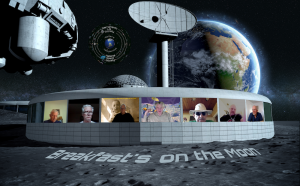
- The YouTube channel contains the series of video conferences that SacL5 organized from 2019 through 2023 to celebrate each of the Apollo Lunar Landing Missions.
- Websites – Cool Links
- Dark Sky Festival
- Meet the artist that shot a bouquet of flowers 30,000 meters into space | CNN
- A Japanese Artist Launches Plants Into Space (nytimes.com)
- Homepage | NOAA / NWS Space Weather Prediction Center
- Webb’s Jupiter Images Showcase Auroras, Hazes – James Webb Space Telescope
- Andry Astronaut You Tube
- NASA Cube Sats
- Dream Chaser
- Books
- Rebecca Doyle is the Author of Our Moon
- Rebecca is a journalist covering the cosmos, with a focus on astronomy, space exploration, and history.
- The late Robert Compton, our SacL5 founder. published a Physics text book like no other.
- Design Notes Log G,O.D (General Operations Director)
- This is a text book like no other. It follows the mental processes of the lonely Creator, defining matter to enhance the experience of existence and then creating time to distinguish matter as it moves. The logic continues in this way to build the intuition and demonstrate the mathematics required in the first few years of college physics courses.
- Some of you may remember that thrill. as you learned the calculus of derivatives providing the symbols that could move the static structures of algebra through the pictures in your mind. Compton’s book continues this thrilling awe that mathematics creates as its symbols correspond mostly to the universe with enough accuracy to create houses and steeples and medicine and instruments to travel beyond the clouds and deep into atoms.
- Design Notes Log G,O.D (General Operations Director)
- A Traveler’s Guide to the Stars” by Les Johnson – Realistic discussions of crewed starship designs / timeframes for a feasible trip to Proxima Centuri in a reasonable amount of time
- “The Sparrow” by Mary Doria Russell – A SciFi novel about the first contact and a a trip to meet singing aliens living near Proxima Centuri. The meeting does not go well.
- The Alice Network – Women Spies in World War 1
- Fly Girls – How Five Daring Women Defied All Odds and Made Aviation History
- Goodnight Moon Base – What if every bedtime was a powerful inspiration for your child’s future?
- Rebecca Doyle is the Author of Our Moon
- Media
- Moonfall – Leave your physics back at home but if you like a series of mostly predictable travails to reflect dim light on your popcorn then go for it.
- Start Trek: Strange New Worlds – “Quality of Mercy” – Last episode of Season 1. Rich characters, deep references, thoughtful reflection on what qualities are mercy
- The Orville: New Horizons – Comedy but good
- Star Trek: Discovery – No universe too big to save and of course, need to save all multi-verses through all time…
- Severance – Hmm…, might that enthusiasm for work, plaques, and quarterly pizza parties really be for someone else?