“When you can measure what you are speaking about, and express it in numbers, you know something about it.”
— Lord Kelvin, Electrical Units of Measurement, 1883
The Zeroth Law — Kelvin’s Law
Lord Kelvin observed that knowledge which cannot be expressed through measurement remains incomplete. It may be the beginning of knowledge, but it has not yet become science.
The important word is beginning.
Every new idea begins with incomplete knowledge. We have observations, intuitions, possibilities, and questions. We may suspect that something can be done without knowing how to do it, or even how to determine whether it has been done successfully.
The path from speculation to knowledge is through evidence. We must discover what can be observed, what can be tested, and ultimately what can be measured.
The Three Laws of Applied Wonder describe a practical way to travel that path.
They are especially useful in the age of artificial intelligence, when the distance between imagining something and producing a working example has become remarkably short.
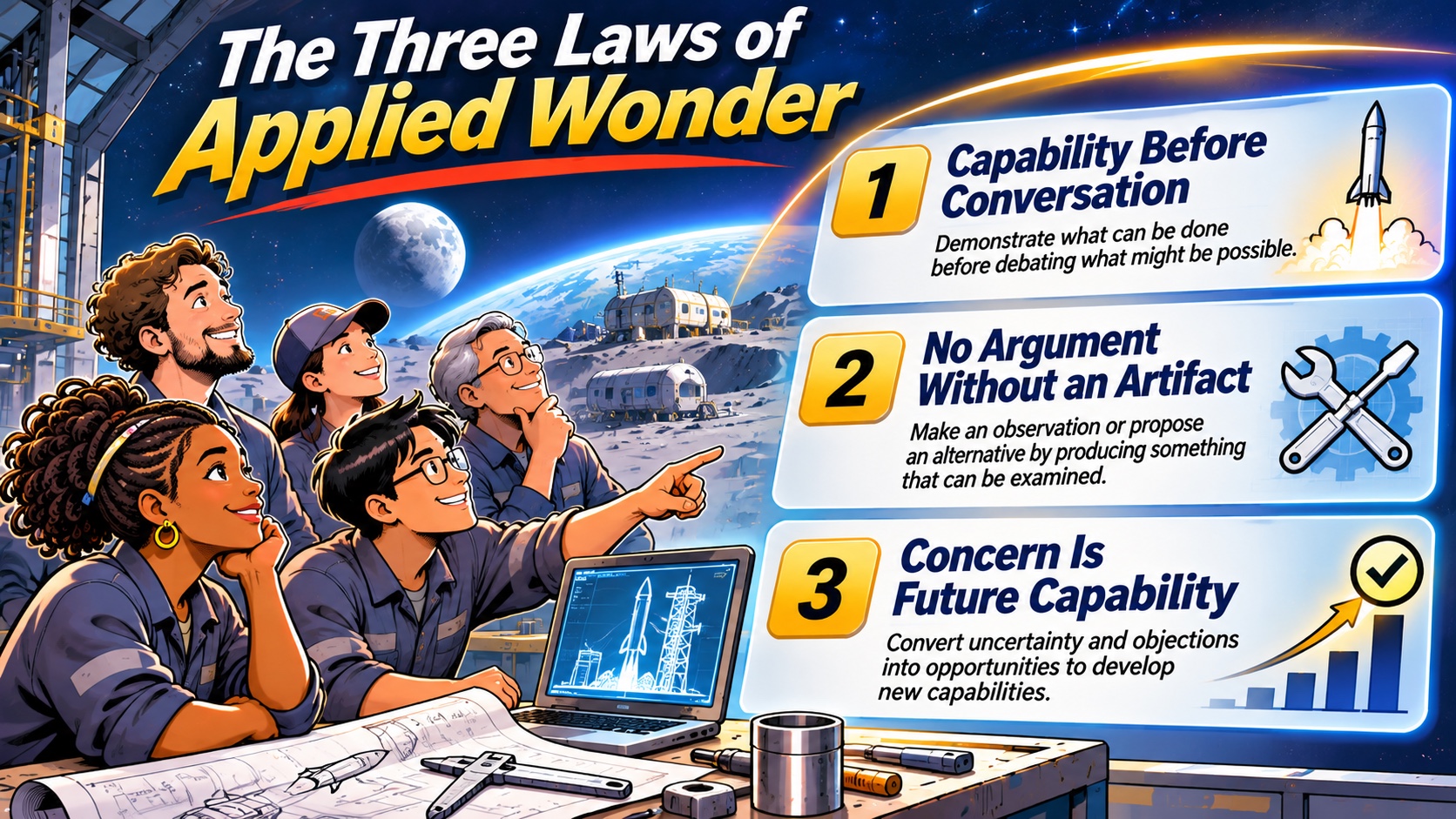
The Three Laws
1. Capability Before Conversation
Traditionally, we begin with conversation. We discuss possibilities, establish requirements, debate approaches, estimate difficulty, and decide whether something is worth attempting.
But conversations about what might be possible are necessarily limited by what the participants already know.
AI changes the economics of exploration.
We can often produce a working demonstration before we could have finished discussing whether it was practical. Instead of asking people to imagine a capability, we can show them one.
The demonstration need not be complete, polished, or even particularly good. It only needs to exhibit enough behavior to make the possibility real.
Once something exists, the conversation changes. We can observe what it does, discover what it cannot do, and identify which properties matter.
We have something to test, improve, and measure.
Capability creates the opportunity for informed conversation.
2. No Argument Without an Artifact
Once something has been built, observations, criticisms, and alternative ideas inevitably follow.
These are valuable, but they can also lead to endless discussion. One person believes a design is inadequate. Another believes an alternative would work better. Neither may have enough evidence to establish the point.
The solution is not to suppress disagreement. It is to make disagreement productive.
If you believe there is a better approach, demonstrate it. If you believe something will fail, devise a test that reveals the failure. If you see a missing capability, produce an example of what that capability might look like.
An artifact need not be a finished device or program. It might be a drawing, a simulation, a test case, a calculation, a modified prototype, or even a reproducible failure.
The important thing is to move the disagreement out of competing imaginations and into something that can be examined.
An artifact gives everyone a common reference. It makes comparison possible and exposes details that discussion alone often overlooks.
An argument asks others to accept a position. An artifact invites them to investigate it.
And investigation leads us toward measurement.
3. Concern Is Future Capability
When presented with something new, people naturally become concerned.
What if it fails? What if it damages something? What about security, reliability, cost, accuracy, or unintended consequences?
These concerns are not obstacles to progress. They are opportunities to discover what needs to be built next.
A concern identifies a possible gap between what a system can presently do and what we need it to do.
Instead of dismissing the concern or endlessly debating its likelihood, we can ask a more productive question:
What capability would resolve this concern?
If we worry about losing data, develop recovery and backup capabilities. If we worry about accuracy, create tests that expose errors. If we worry about unexpected behavior, build mechanisms to observe and contain it.
Some concerns reveal genuine limitations. Others disappear when a working demonstration shows that the feared problem does not occur. Either outcome advances our knowledge.
Not every concern can be resolved immediately, and some may justify stopping until adequate safeguards exist. But even then, the concern has identified something specific that must be understood or accomplished.
Concern becomes a source of requirements, experiments, and new capabilities.
Don’t be concerned about your concern. Concern is future capability.
From Wonder to Knowledge
The Three Laws form a continuing process.
We begin by creating a capability. The capability gives us something real to examine. Examination reveals limitations, disagreements, and concerns. Those observations inspire new artifacts, tests, and capabilities.
And each iteration gives us new opportunities to measure what previously existed only as an idea.
This is not a rejection of careful engineering or scientific rigor. It is a way of reaching them.
We do not need complete knowledge before we begin. We do not need to settle every argument before building. And we do not need to eliminate every concern before discovering how to address it.
We need a way to proceed from what we imagine to what we can demonstrate, from what we demonstrate to what we can test, and from what we test to what we can know.
Lord Kelvin gave us the destination.
The Three Laws of Applied Wonder give us a way to get there.
And in the age of AI, the invitation is simpler than ever:
Start building.