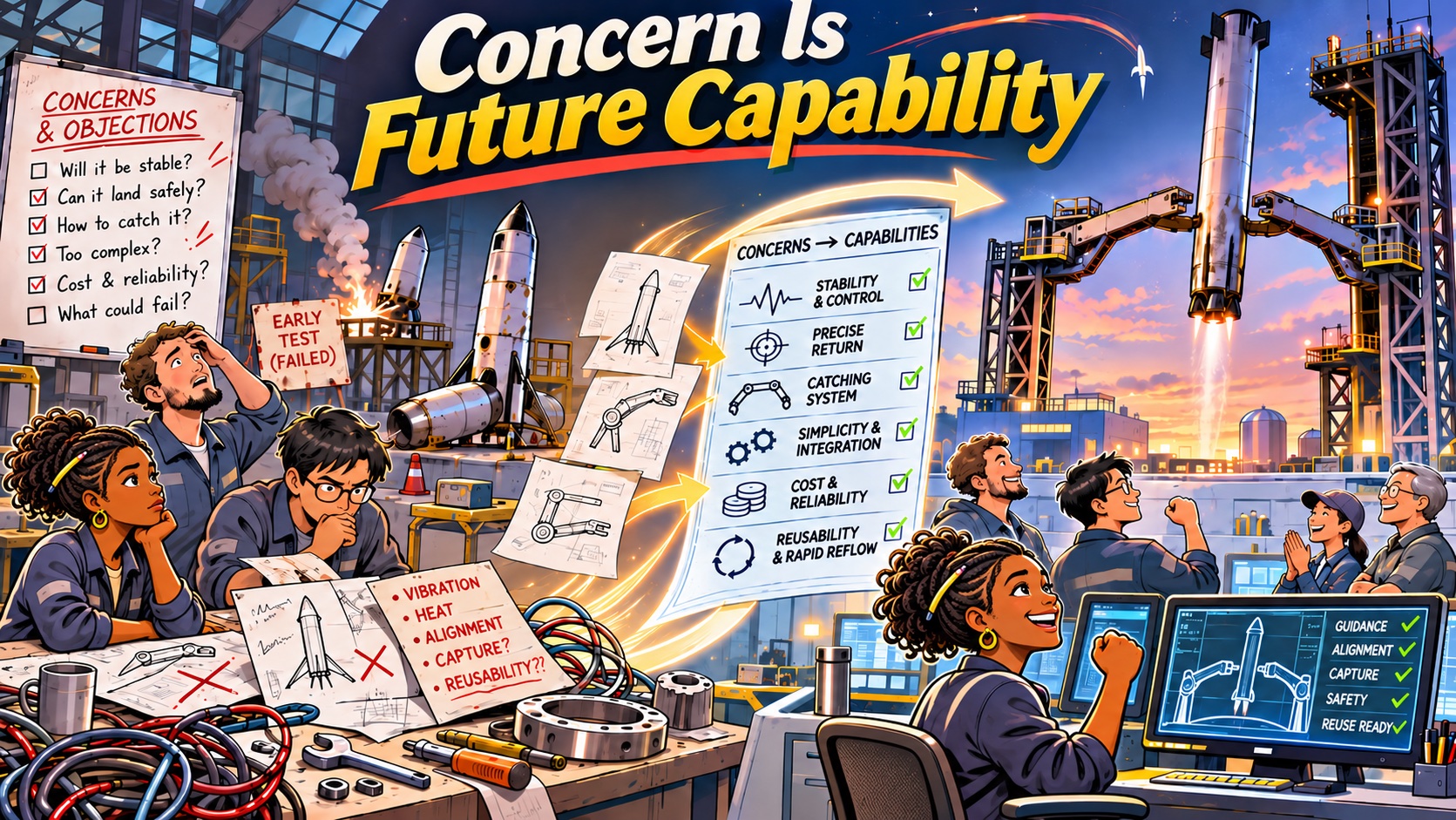
When someone presents a new idea, it is almost inevitable that someone else will identify a problem.
What if it fails? What if it damages something? What about security, reliability, cost, accuracy, or unintended consequences?
These are reasonable questions. In fact, they are often excellent questions.
But there is a profound difference between identifying a concern and treating that concern as a reason to stop.
A concern is not necessarily an obstacle. It may be a description of a capability we have not yet developed.
From Objection to Opportunity
Consider the development of reusable rockets.
For decades, rockets were generally treated as expendable vehicles. They performed their mission, and most of the hardware was discarded.
The idea of recovering and reusing a rocket raised an impressive collection of concerns.
How would it survive reentry? How could it control its descent? How much additional fuel would it require? Could it land precisely? Would the recovered rocket be reliable enough to fly again? Would recovery cost more than building a replacement?
All legitimate concerns.
But each question also described something that could be investigated, tested, and developed.
The concern about reentry became a problem of thermal protection and controlled descent. The concern about landing became a problem of guidance and propulsion. The concern about reliability became a problem of inspection, testing, and reuse.
Eventually, SpaceX demonstrated something that would once have seemed extraordinary: a returning Super Heavy booster being caught by mechanical arms on its launch tower.
The concerns did not disappear because someone won an argument.
They were transformed into engineering capabilities.
The Question That Changes Everything
When someone expresses a concern, our instinct is often to defend the idea.
We explain why the problem is unlikely, why it has already been considered, or why the benefits outweigh the risks.
Sometimes that defense is justified. But it can also turn a useful observation into an unproductive argument.
There is a better question:
What capability would resolve this concern?
If we are concerned about losing data, perhaps we need automatic backups and reliable recovery.
If we are concerned about inaccurate results, perhaps we need independent verification, comparison tests, or a way to identify uncertainty.
If we are concerned that a system may do something unexpected, perhaps we need monitoring, containment, and a reliable way to stop it.
Notice what has happened.
Instead of defending the existing system, we have identified something new that we can build.
The concern has become a requirement.
And the requirement has become an opportunity.
Artificial Intelligence Changes the Economics
Traditionally, responding to a concern could require substantial planning, funding, and development effort.
A suggestion that sounds simple might represent weeks or months of work. Consequently, people learned to resist new requirements, particularly when a project was already underway.
Artificial intelligence changes this calculation.
Not every problem is easy, and the physical world still imposes its costs and limitations. But many capabilities that once required significant software development can now be prototyped surprisingly quickly.
We can ask AI to develop a diagnostic tool, add a safety check, construct a simulation, generate test cases, or demonstrate an alternative approach.
We can often explore the proposed solution before deciding whether it deserves a substantial investment.
This creates a remarkable opportunity.
Instead of spending our time arguing about whether a concern is important, we can spend some of that time discovering what it would take to resolve it.
And the results may surprise everyone involved.
Don’t Solve a Problem You Only Think You Have
There is an important qualification.
Not every concern describes a real problem.
Sometimes we worry about circumstances that cannot occur. Sometimes we misunderstand how a system operates. Sometimes the supposed failure would have no meaningful consequence.
And sometimes our proposed solution introduces more problems than the original concern.
This is why the first response need not be to build a complete solution.
We can begin by building a test.
Can we reproduce the feared failure? Can we measure its consequences? Can we demonstrate that a safeguard works? Can we discover whether the concern actually matters?
Even a failed experiment can advance our understanding.
The objective is not to eliminate every imaginable risk. It is to discover which concerns matter and develop the capabilities appropriate to them.
Make sure the problem is a problem before you attempt to fix it.
Concern Is an Invitation to Participate
There is another important consequence of this way of thinking.
When people express concerns about something unfamiliar, particularly artificial intelligence, they may be expressing more than skepticism. They may be identifying a missing piece of their own understanding.
They cannot yet see how the system will behave, how it can be controlled, or how its failures can be detected and corrected.
These are opportunities to demonstrate capabilities.
Rather than telling someone that their concern is unfounded, we can invite them to help establish what would resolve it.
What would they need to see? What test would convince them? What behavior would they consider acceptable? What capability would make them comfortable proceeding?
The answers can lead to better requirements, better experiments, and better systems.
And sometimes the person who raised the concern becomes the person who helps create the solution.
From Concern to Capability
This is the Third Law of Applied Wonder, and it connects naturally to the first two.
Capability Before Conversation encourages us to demonstrate what is possible rather than endlessly discussing it.
No Argument Without an Artifact encourages us to support observations and alternatives with something that can be examined.
Concern Is Future Capability encourages us to treat objections and uncertainties as opportunities to discover what should be built next.
Together they form a continuing process.
Build something. Examine it. Discover what is missing. Build the next capability.
Each iteration creates new opportunities for observation, testing, and measurement. Our knowledge grows because we are working with something real.
There will always be concerns. Every new capability introduces questions we could not have asked before it existed.
That is not a defect in the process.
It is how the process advances.
Don’t be concerned about your concern. Concern is future capability.